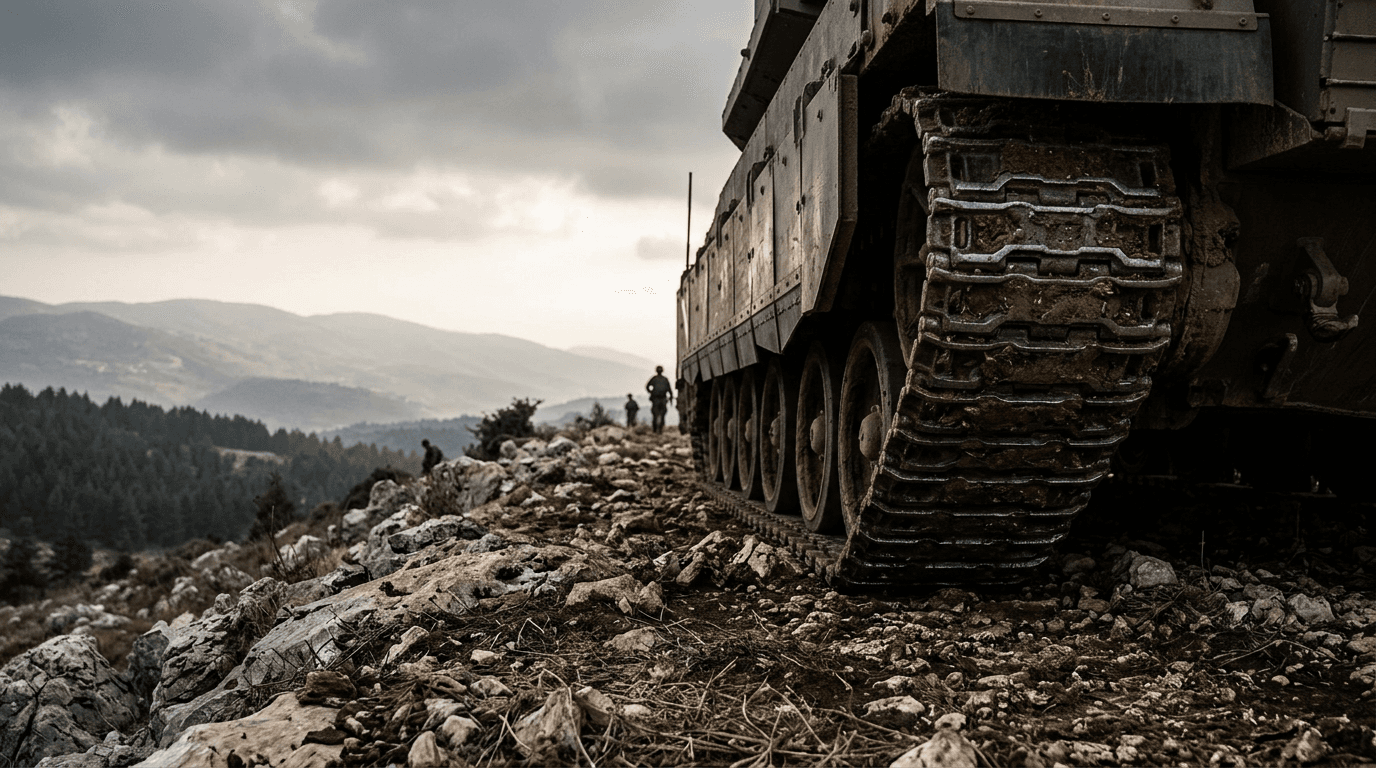
The IDF disclosed Saturday that four tank soldiers killed overnight Thursday–Friday in Kfar Tibnit were engaged in an operation to seize a large underground Hezbollah network on the Ali al-Taher ridge — described as the group's main headquarters in southern Lebanon. Dozens of Hezbollah operatives are reportedly trapped inside the complex as fighting continues underground. A senior officer rejected Hezbollah's claim that the operation violates the ceasefire.
The IDF on Saturday evening disclosed that the four tank soldiers killed overnight Thursday–Friday in Kfar Tibnit were engaged in an operation to seize Hezbollah's main underground command center on the Ali al-Taher ridge. Senior military officials described the complex as an 'unprecedented strategic infrastructure' — the nerve center of Hezbollah's Badr unit in southern Lebanon, consisting of multiple subterranean compounds, the longest exceeding one kilometer. Dozens of Hezbollah operatives are reported trapped inside as fighting continues underground. A senior officer rejected Hezbollah's claim that the operation violates the ceasefire, arguing the ridge lies south of the IDF's unilaterally declared 'yellow line,' and referred further questions to the political echelon.
The IDF's initial probe now indicates the tank was hit by an external drone carrying a warhead of an anti-tank missile, contradicting earlier speculation of a mechanical malfunction. This finding comes after a sequence of reports: on Friday at 09:31 Jerusalem, The Zioneer first reported that four tank soldiers had been killed by a Hezbollah anti-tank missile, with the battalion commander among them. By 09:31 Friday, the IDF had named Lt. Col. Dor Gedalia Ben Simhon, 32, commander of the 52nd Battalion, as one of the fallen. Subsequent versions at 09:31 Friday refined the cause — initially a suspected explosive drone, then confirmed as an anti-tank missile strike. Hezbollah issued a detailed claim of responsibility on Friday afternoon, describing a tactical ambush involving ATGMs and artillery to block an IDF advance toward the Ali al-Taher ridge.
As The Zioneer reported on June 17, air strikes were first reported near Kfar Tibnit. By June 19, heavy ground fighting erupted, with Hezbollah claiming three Merkava tanks destroyed in an ambush near Mount Ali Taher. The IDF subsequently expanded its strikes to over 150 targets across southern Lebanon, while Defense Minister Israel Katz vowed troops would remain in the security zone. The fighting on the Ali al-Taher ridge continued into Friday night, with close-quarters combat reported.
It remains unclear how many Hezbollah operatives are still holding out inside the underground complex, and whether the IDF intends to hold the facility or demolish it. The IDF's characterization of the 'yellow line' — a unilateral demarcation not agreed by Hezbollah — has drawn questions about the legal basis for continued operations under the ceasefire framework.
10 developments
- DevelopingIDF says it struck 70+ Hezbollah sites, eliminated seven operatives from underground route
- DevelopingIDF kills two Hezbollah operatives fleeing rocket launch site in southern Lebanon
- StrongIDF says Hezbollah fired over 50 rockets at troops in south Lebanon overnight; strikes dozens of targets in response
- StrongHezbollah footage claims to show anti-tank missile strike on IDF tank that killed four soldiers
Source and signal
- Open-source intake